The proof · a full case study
One round of work on a real company. Every screen, raw.
An Oahu-based solar panel cleaning company. We built the site, fixed the Google profile and set up tracking, once. Nothing monthly after that. Below are its own Google screens, with names and locations scratched out, and an estimate of what the leads could be worth that you can set yourself.
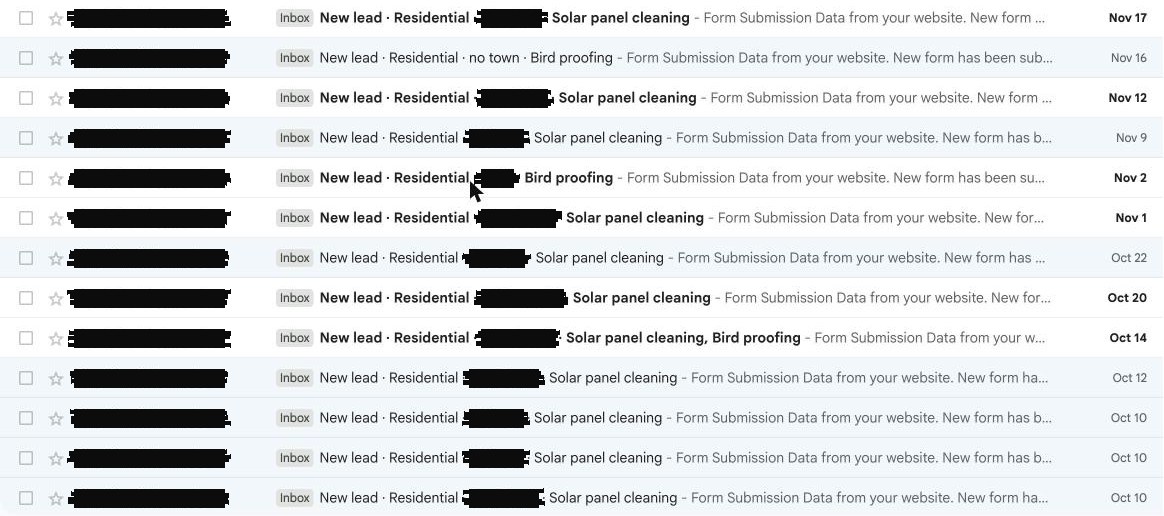
The lead inbox
Get your inbox looking like this
Quote requests from the site, as they arrived. Each line says what the job is before you open it.
Nine weeks before, nine weeks after
The numbers
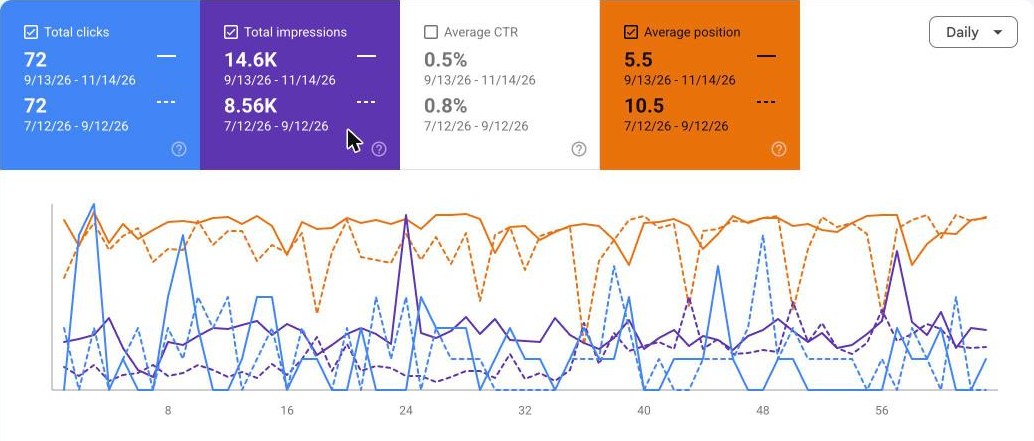
Search numbers compare July 12 to September 12, 2026, against September 13 to November 14, 2026. The new site went live in mid-September.
The raw screens
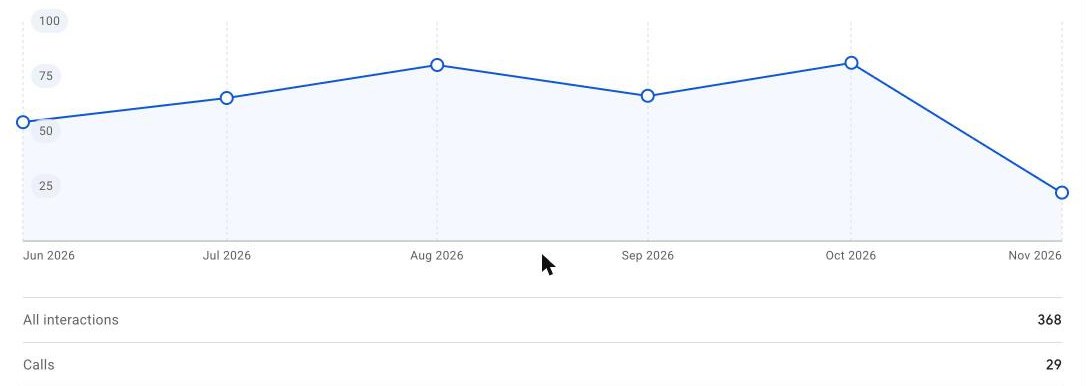
Straight out of the accounts
Cropped to the part that matters. Nothing redrawn. Black marks are ours.
What could that be worth a month?
Set the numbers yourself
We do not publish what this owner booked or charged. So this is an estimate, not a result. The sliders start at the real monthly counts from this one round and at published average prices. Move them to match your own business.
A projection from the sliders, not this company's revenue and not a promise. Set growth to 0 to see the flat case. Real growth slows as a crew fills up; this line does not.
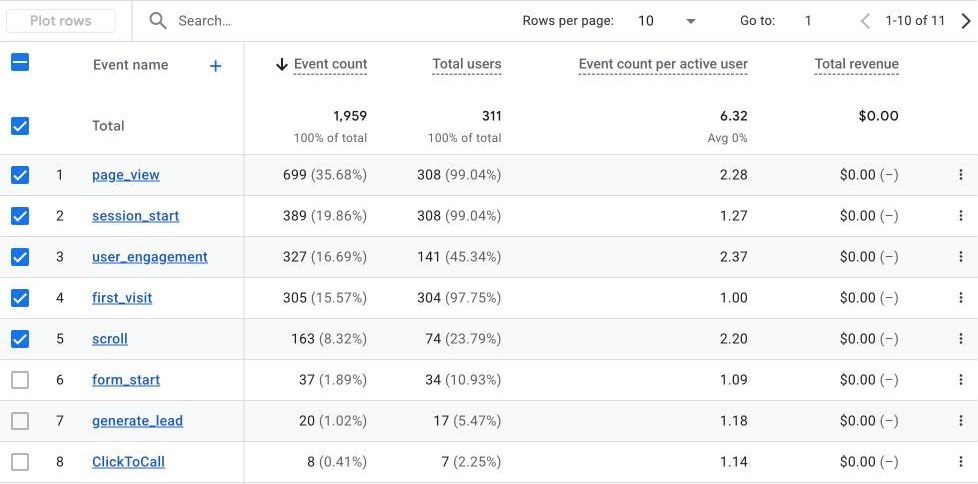
Where the starting values come from. Seven requests a month: 16 real requests in about nine weeks. Eleven calls a month: 23 calls in about nine weeks, 15 from the Google profile and 8 call taps on the site. Not every call is a job inquiry, so the estimate counts 40% of calls, the share Invoca reports as real job opportunities across home services. About one request in five (3 of 16) asked for bird proofing, the bigger job here; the slider starts at one in four, the share we would aim for once the form asks about it. Cleaning at $12 to $20 a panel: Thumbtack cost guide. An average home has 16 to 23 panels: EnergySage. Bird and critter proofing at $500 to $2,000 a job (the slider starts at the top of that range): SolarReviews; few guides price it, and local quotes can run higher. The share that become jobs starts at 55% because these are people who asked for a quote; it is our assumption. For scale, ServiceTitan reports a median close rate of 31% to 38% across its own customers and 70% and up for its top quarter. Growth starts at 8% a month, also our assumption. What is real: the requests came in as 2 in the second half of September, 7 in October, and 6 in the first 17 days of November. Checked November 2026.
Why the line should climb
One round is the floor, not the ceiling
Everything above came from a single round of work. One build, one pass on the Google profile, tracking switched on, then nothing. No monthly work followed it. That is the weakest version of what we do, shown on purpose.
Kept up, the same system has more to work with every month:
- More pages. Each service and each area served gets its own page, so the site is shown for more searches.
- More reviews. Every finished job is asked for one. Reviews lift the profile, and the profile is where most local customers start.
- More data. Each month of tracking shows which pages and which jobs bring the money, and the next round goes there.
- The bigger job, on purpose. When one request in five is the larger job, we write for it, film it and ask about it on the form.
That is what the growth slider stands for. It is our expectation and the reason for it, not a guarantee, and you can set it to zero.
How we worked
What one round actually was
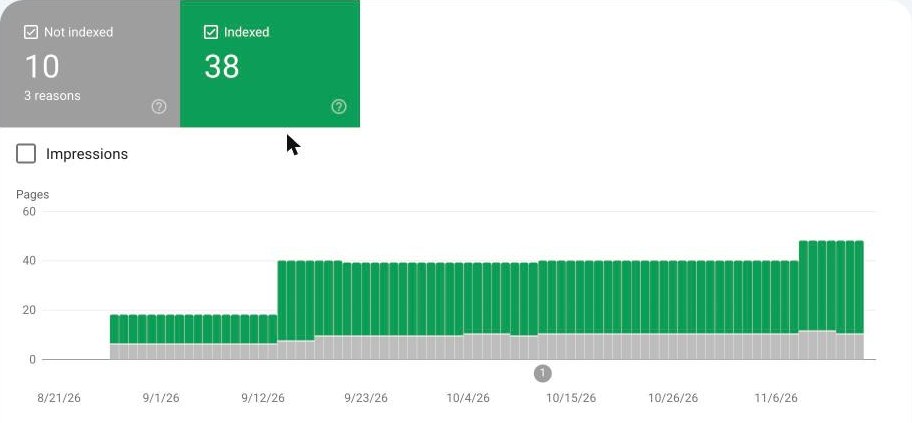
We normally run two or three rounds of interviews and content gathering with the owner: what you do, how you do it, the jobs you want more of, your own photos and footage. This company got one, and it was a big one. We sat down for interviews about the business and its story, gathered every photo and video it had, and built a page for each service and each area it wants to be found in: thirty pages where there had been fourteen.
We audited what was already there. The old site had fourteen pages, a duplicate home page and a reviews section that showed nothing. The company had been paying for search work for about two years: about $250 a month at first, then about $400 a month for the last several months. In all that time the services published one article and built about 180 links, nearly all from unrelated overseas sites and throwaway directories (a cheese company's website among them), every one pointed at the home page. The links moved nothing. The one article was about a single service, and the company's three best months on record followed it. That told us what would work: real pages about real work.
We found the mistakes on the Google profile and fixed them. Google had the business filed under the wrong category, so it was being shown to people looking for a different service. We corrected the category, cleared out the wrong ones, listed the real services and put a tracked link on the website button. Google accepted every edit.
We used paid search data, not guesses. Before writing a page we look up how many people search for that service in that area, with third-party search software, and build pages for the searches that exist.
We tracked from the first day. Every form sent and every tap on the phone number is recorded, with a frozen before-picture, so the after is a real comparison and not a feeling.
What did not move
The parts that stayed flat
The main search term stayed where it was. The broadest search for this service on the island sat at about twelfth before and about twelfth after. The gain came from the Google profile and from the individual service pages, not from the headline term.
Clicks did not change. Seventy-two before, seventy-two after. Being shown more often and sitting higher did not yet turn into more clicks in this window. The quote requests are the number that mattered to the owner.
The Google profile held level. It was busy before and stayed about as busy.
We would rather show you this than a chart with the flat lines cropped out.
Why it moved fast
This company was ready
It already had Google reviews and years of customers. The site and the profile gave Google something accurate to show for a business people already trusted. A newer company doing the same work should expect it to take longer. That is not a disclaimer, it is the reason we sort people before we sell anything.
Keep reading
Where this connects
If you have reviews and customers already, this is the path. If not, here is what comes first.
Where should you start →The parts we touchedWebsite, Google profile, tracking, and how they feed each other.
The foundation →Same trade?If you run a solar or panel cleaning company, start with the page written for you.
Solar companies →Where most businesses start
The Starter System
The point is to get found on Google and get your reviews up. It is three things:
A starter website, built at no build fee and yours once the first month is paid.
Your Google Business Profile, set up and optimized.
The small systems that run on their own: every lead in one app on your phone, a text back when you miss a call, a text to every new lead within minutes, and a Google review request after each job.
No Google profile yet? Set it up first, then ask every past customer for a review. Leads pick up as the reviews do. Bigger systems come after, when the numbers call for them.
We will open the account on the call
You see the numbers where they live, not a slide about them.